Smart Farming Pays Off Most Where Decisions Are Hardest
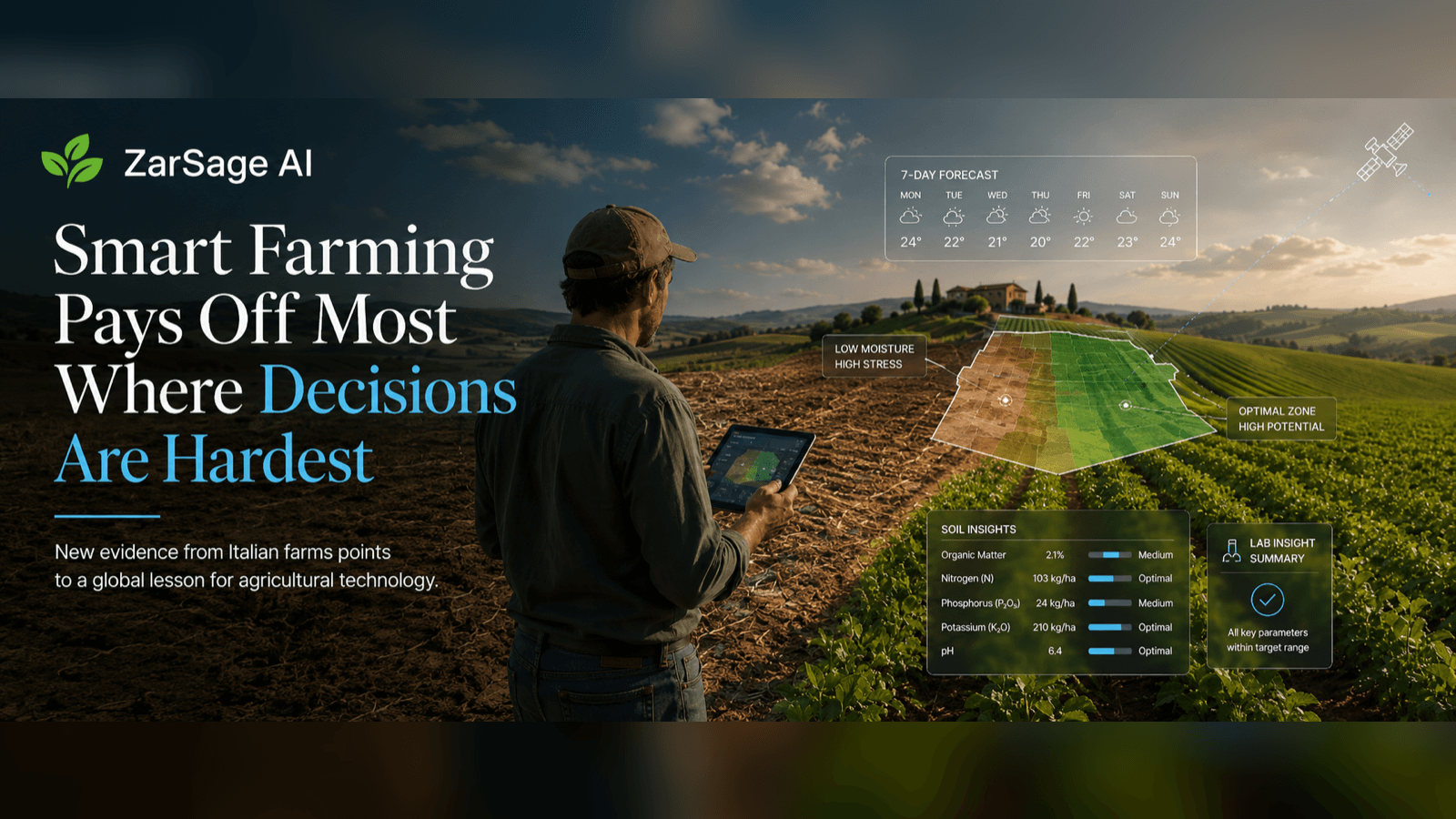
New evidence from Italian farms suggests digital agriculture creates the most value when it helps growers make better decisions under real constraints, not when it simply adds another dashboard.
There’s a common assumption in agtech: that smart farming is for large, well-resourced farms, the ones that already have modern machinery, advisory support, and capital to experiment. New research from the University of Bologna points to something more useful. Smart farming may deliver its biggest gains exactly where farming decisions are hardest.
In a 2026 study in Smart Agricultural Technology, Yogendra Katuwal, Giulia Maesano, and Davide Viaggi surveyed 345 Italian farms, asking not just who adopts these technologies but what farmers say changes afterward. Three findings stand out, and each shapes how we think about ZarSage AI.
The biggest gains show up where constraints are strongest
Adoption was higher in Northern and Central Italy, regions with stronger infrastructure and more mature innovation networks. No surprise there. But the largest reported benefits, in revenue, cost savings, and input efficiency, came from farms in the South and the Islands, where baseline constraints are more severe.
In other words, the technology delivered its biggest marginal gains where the starting point was hardest. The authors describe this as narrowing performance gaps.
That’s a lesson well beyond Italy, because the constraints are familiar everywhere: rising input costs, water pressure, uncertain weather, and limited access to timely expert advice. The value of smart farming isn’t mainly about piling more technology onto already-advanced farms. It’s about helping a grower close the gap when decisions are made with incomplete information. That’s the problem ZarSage AI is built to solve, for the person running their own operation and making the calls themselves.
Decision tools matter more than record-keeping
The study sorted technologies into seven categories. The strongest perceived impacts came from tools that directly support a decision or a field operation: decision support systems, data-collection tools, and robotics. The more modest gains came from management-oriented software like farm management systems and cloud platforms.
That distinction is the whole game. There’s a difference between software that stores your farm and software that helps you decide. Record-keeping is useful, but the return shows up when technology answers the questions a grower actually faces. What does this soil test mean? Which field needs attention first? Is this a good spray window? How much fertiliser is actually needed? What should I do next?
That is also the lens to use when you compare AI for farming: separate tools that organize data from tools that help interpret conditions and recommend the next action.
That’s where ZarSage AI sits. It isn’t a filing cabinet for field data. It connects your soil reports, weather history, field records, and satellite signals, and uses AI to turn them into a clear recommendation for your fields, on your farm.
The barrier isn’t age. It’s confidence.
Maybe the most practical finding: adoption wasn’t explained mainly by a farmer’s age or formal education. It was linked to digital knowledge and to being connected to a cooperative or network.
So the obstacle isn’t that some farmers are “too old” or “not educated enough.” The real barrier is confidence: whether the tool is understandable, trustworthy, and fits the way work already happens.
That’s a design mandate, not a footnote. If a tool demands heavy setup, endless manual entry, or technical interpretation, most people quit before they reach the value. So ZarSage AI is built to remove that friction. Import a soil lab report as a file instead of typing every value, and get recommendations explained in plain language, so you can understand them, question them, and act with confidence. Confidence isn’t a nice-to-have; the evidence says it’s part of adoption.
One honest caveat
The study measured perceived impact: what farmers reported after adopting, not independently verified yield maps or financial records. That matters. Perceived benefit is still real signal, because a grower knows whether a tool saves time or sharpens a decision. But the next step for digital agriculture is stronger measurement.
That’s part of where we’re headed. As soil reports, weather, tasks, and crop outcomes come together in one workspace, the longer-term goal isn’t only to recommend an action, but eventually to help show whether that action improved the result. The future should be built on evidence, not just promises.
The takeaway
The evidence points one way. Smart farming creates the most value when it helps someone make a better decision under real constraints, not when it stores more data or looks more modern. The return comes when technology helps a grower decide what to do next, with better context, clearer reasoning, and more confidence.
That’s what ZarSage AI is built for: turning soil, weather, satellite, and field data into decisions you can actually use, wherever you farm.
Reference: Katuwal, Y., Maesano, G., & Viaggi, D. (2026). Smart farming technology adoption and perceived impacts: Evidence from Italian farms. Smart Agricultural Technology, 14, 102216. Read the full study
Acknowledgement: With thanks to Yogendra Katuwal, Giulia Maesano, and Davide Viaggi of the Department of Agricultural and Food Sciences, University of Bologna, whose research informs this article. All interpretations and product views expressed here are ZarSage’s own.