How to Interpret a Soil Lab Report for Fertilizer Decisions
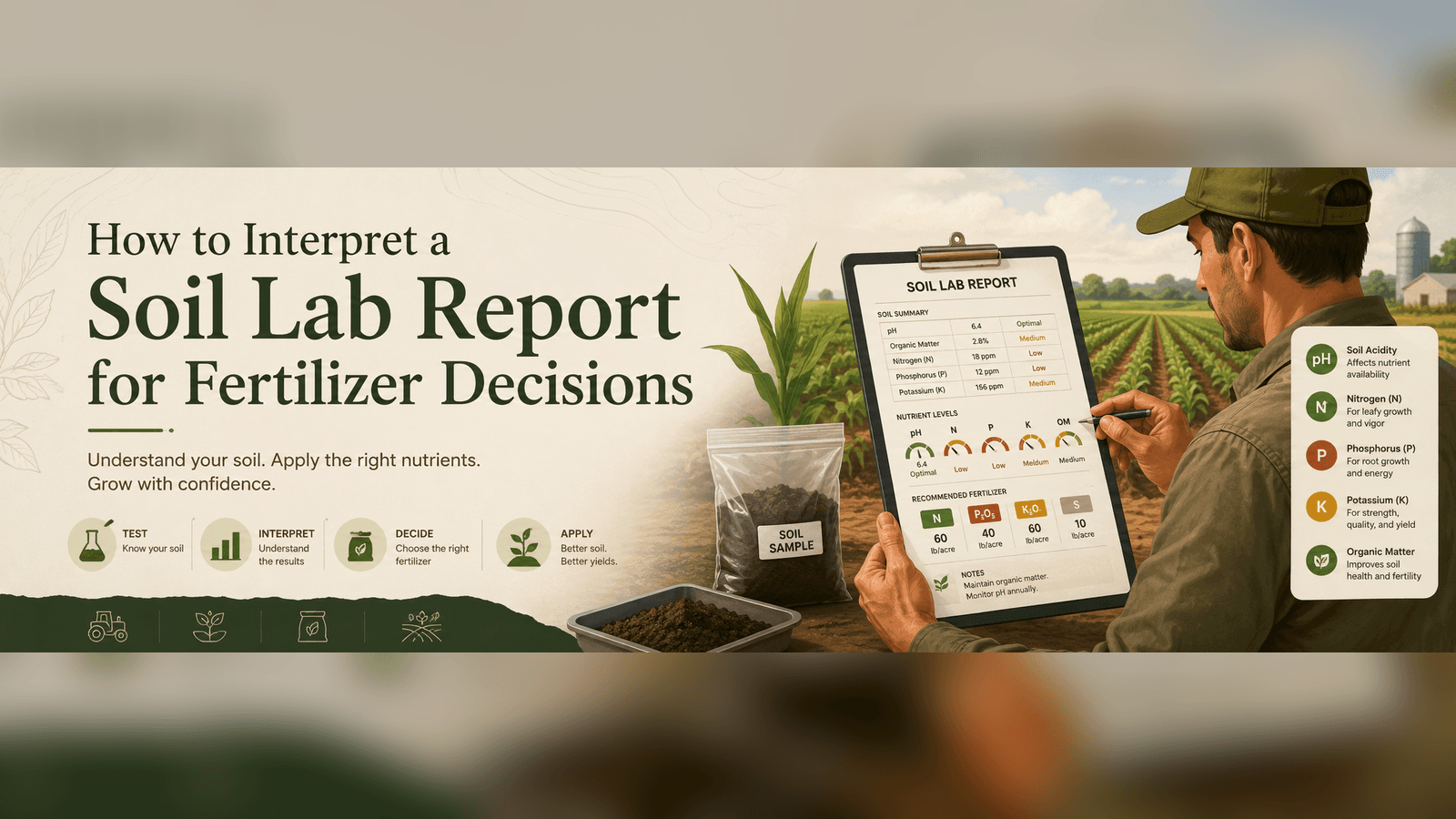
Soil testing is one of the most useful tools in crop management, but a soil lab report is only valuable if it changes the decision you make in the field.
That matters more in 2026 because input decisions are still under pressure. USDA ERS forecasts U.S. farm production expenses at $477.7 billion in 2026, and fertilizer remains one of the input categories growers watch closely. Even when fertilizer prices are below the extreme highs of 2021 and 2022, every unnecessary application still ties up cash and can create agronomic or environmental risk.
A soil report helps answer a practical question: what does this field actually need, for this crop, at this point in the season?
The difficult part is that the report is not a recommendation by itself. It is a measurement. To turn it into a fertilizer plan, you need to understand what the numbers mean, how the sample was collected, what crop is being grown, and what field conditions may change nutrient availability.
The examples and sources below lean on U.S. extension guidance because those publications are detailed and transparent, but the decision logic is not U.S.-only. Whether your report uses pounds per acre or kilograms per hectare, inches or centimeters, the same questions matter: was the sample representative, which crop is being managed, what units and test methods were used, and which local thresholds should guide the final recommendation?
Start with the basics: what the report is measuring
Most soil test reports include a mix of soil condition indicators and nutrient measurements.
The most common values include:
- soil pH
- buffer pH, when lime is relevant
- organic matter
- phosphorus
- potassium
- calcium and magnesium
- cation exchange capacity, usually written as CEC
- electrical conductivity or soluble salts
- micronutrients such as zinc, boron, manganese, copper, and iron
- fertilizer or lime recommendations
Some labs report exact numbers. Others group nutrients into categories such as low, medium, optimum, high, or excessive. Both formats can be useful, but they need context. A “low” phosphorus result may require action for one crop and be less urgent for another. A “high” potassium result does not automatically mean a problem. A report is a decision input, not a script.
Soil pH controls nutrient availability
pH is usually the first number to check because it affects how available nutrients are to the crop.
A pH below 7 is acidic. A pH above 7 is alkaline. Many crops perform best in a slightly acidic to neutral range, but the correct target depends on the crop, region, soil type, and management goal.
The important point is that pH changes how nutrients behave. Phosphorus, for example, can become less available in very acidic soils and also less available in alkaline soils. A field may have enough phosphorus present in the soil, but if pH is outside the effective range, the crop may not be able to use it efficiently.
That is why lime recommendations matter. If a soil is too acidic, correcting pH can sometimes improve nutrient availability before adding more fertilizer. Buffer pH helps estimate how much lime is needed because some soils resist pH change more than others. Clay soils and soils with more organic matter often require more lime to move pH than sandy soils.
Organic matter is a slow-moving signal
Organic matter is not just a “soil health” number. It affects water holding, nutrient cycling, aggregation, and the soil’s ability to hold nutrients.
Higher organic matter usually supports better nutrient retention and more resilient moisture behavior. Low organic matter can mean nutrients move through the system more easily, especially in coarse-textured soils. But organic matter does not change quickly. It reflects years of crop rotation, residue management, tillage, cover crops, compost, manure, drainage, and climate.
For fertilizer decisions, organic matter helps explain how the soil behaves. A low-organic-matter sandy field and a high-organic-matter clay loam can have the same potassium number but very different risk of nutrient loss and drought stress.
CEC tells you how well the soil can hold nutrients
CEC, or cation exchange capacity, measures how well soil can hold positively charged nutrient ions such as potassium, calcium, and magnesium.
Soils with more clay and organic matter usually have higher CEC. Sandy soils and low-organic-matter soils usually have lower CEC. That matters because low-CEC soils have less capacity to hold some nutrients in the root zone. They may need smaller, better-timed applications rather than one large application.
CEC is also useful when interpreting potassium. Ohio State University Extension notes that CEC affects potassium fertilizer decisions because lower-CEC soils have a greater risk of potassium leaching below the root zone.
One caution: CEC is not something you fix quickly. It is a soil property that changes slowly. It should shape your management strategy, not trigger a quick product purchase.
Phosphorus and potassium are not read like nitrogen
Phosphorus and potassium are often central to fertilizer planning, but they behave differently from nitrogen.
Phosphorus is relatively immobile in soil. Oregon State University Extension notes that previous banded phosphorus applications can leave concentrated zones that complicate interpretation. That means a sample taken through a previous fertilizer band may not represent the whole field well.
Potassium is more mobile than phosphorus but still depends heavily on soil texture, CEC, clay mineralogy, crop removal, and moisture conditions.
The practical rule is simple: look at phosphorus and potassium as calibrated soil-test indicators, not as the total amount of nutrient in the field. Land-grant university recommendations are usually built from studies that connect soil test values with crop response. As soil test levels rise, the expected response to more fertilizer usually falls.
That is why adding more nutrient when the report already says “optimum,” “high,” or “excessive” is often wasted money. For phosphorus especially, over-application can also increase runoff risk when soil moves off site.
Nitrogen requires extra context
Nitrogen is harder to manage from a single soil test because it changes quickly.
Nitrate can move with water. Mineralization changes with temperature, moisture, organic matter, residue, and microbial activity. Rainfall after sampling can change the available nitrogen picture. Irrigation can change it too.
For crops where nitrate testing is used, sample depth matters. Montana State University Extension notes that sample depth is needed to convert nitrate reported in ppm into pounds per acre. In metric systems, the same issue appears as converting mg/kg or ppm into kg/ha for the sampled layer. Deeper sampling is often needed for nitrate or sulfate decisions in annual crops.
That is one reason nitrogen recommendations should be tied to more than a lab number. The crop, yield goal, previous crop, manure history, irrigation, rainfall, soil texture, and timing all matter.
Electrical conductivity and salts can explain stress
Electrical conductivity, often shown as EC or soluble salts, gives a signal about salinity.
High soluble salts can interfere with water uptake and seedling establishment. In some regions, salinity is a major yield limiter. In others, it is mostly a concern in greenhouses, high tunnels, irrigated systems, or fields receiving manure, compost, or certain amendments.
If a crop looks drought-stressed even when moisture seems adequate, or if emergence is uneven, EC can be worth checking alongside soil moisture, irrigation water quality, texture, and compaction.
Sample depth and sampling method can change the whole interpretation
The easiest way to misread a soil report is to ignore how the sample was collected.
A soil test is only as representative as the sample. If the sample came from an unusual patch, a headland, a wet spot, a manure pile edge, or an old fertilizer band, the results may not describe the management area you care about.
Before acting on a report, check:
- the field or zone sampled
- sample depth
- sample date
- number of subsamples in the composite
- crop or crop rotation
- previous fertilizer, manure, or lime applications
- whether the sample represents one field, one lot, one management zone, or a mixed area
Montana State University Extension suggests multiple subsamples per composite sample because soil characteristics vary across a field. That principle matters for any serious fertilizer plan. One handful of soil should not drive a major input decision.
The crop changes the answer
The same soil report can lead to different decisions depending on what is being grown.
A vegetable crop, orchard, vineyard, pasture, wheat field, corn field, greenhouse crop, or cover crop can have different pH targets, nutrient demand curves, rooting patterns, and sensitivity to salts or micronutrients.
Crop stage also matters. A nutrient shortage before a major uptake period is different from the same shortage late in the season. A fertilizer plan should connect soil status with crop timing, expected yield, weather risk, and the realistic window for application.
This is where many generic soil interpretations fall short. They explain the number, but not the timing.
Common mistakes when reading soil lab reports
Here are the mistakes we see most often.
Treating “more” as automatically better. If phosphorus or potassium is already high, adding more may not improve crop growth.
Ignoring pH. Nutrient availability often depends on pH. Sometimes the better move is lime, sulfur, or a crop-specific pH correction plan, not more fertilizer.
Comparing reports from different depths. A 0-6 inch sample and a 0-12 inch sample, roughly 0-15 cm and 0-30 cm, are not always directly comparable.
Comparing reports from different labs without checking methods. Different extraction methods can produce different numbers.
Using one sample for too much acreage. Mixed fields hide variability. Zones with different texture, slope, irrigation, yield history, or management should often be sampled separately.
Ignoring weather. A recommendation made before heavy rain, drought, heat stress, or a missed application window may need to be revisited.
Forgetting crop history. Previous manure, cover crops, residue, crop removal, and yield history all affect the interpretation.
Using foreign thresholds without local adjustment. A recommendation table calibrated for Iowa corn, Maryland turf, or Oregon vegetables should not be copied blindly into a Nigerian maize, tomato, rice, or sorghum system. Use local lab methods, crop response data, extension guidance, and regional experience whenever they are available.
A better workflow for fertilizer decisions
A stronger workflow starts by treating the soil report as one layer of evidence.
First, confirm the sample details. Make sure the depth, field, date, and management zone are clear.
Second, identify constraints before nutrients. Check pH, salinity, organic matter, CEC, compaction risk, drainage, and moisture conditions. These can explain why nutrients are not behaving as expected.
Third, focus on the nutrients most likely to limit the current crop. Not every number on the report deserves equal attention.
Fourth, compare the report with field history. Past fertilizer, manure, crop removal, yield maps, crop observations, and previous soil tests can show whether the field is trending up, down, or stable.
Fifth, connect the plan to timing. Fertilizer decisions should account for weather windows, crop stage, soil moisture, equipment access, and application risk.
Finally, document what was applied and why. Record rates in the units your team actually uses, such as kg/ha, bags per hectare, lb/acre, or product per field. The next soil test is much easier to interpret when you can see the decision history.
Where ZarSage AI fits
ZarSage AI is built around the idea that agronomic decisions need context.
A soil lab report by itself can tell you what was measured. It cannot fully explain what matters for a field, crop, weather pattern, or task plan. ZarSage brings those layers together in one desktop workspace: field boundaries, soil lab data, historical weather, crop cycles, tasks, local documents, and AI-assisted interpretation.
For a broader buyer view, see our guide to the best AI tools for agriculture in 2026, which compares platforms by use case and shows where agronomic analysis fits alongside monitoring, management, and precision application tools.
That means an agronomist or farm team can ask better questions:
- Which fields have low pH and high nutrient risk?
- Which soil results are old enough to retest?
- Which fields need fertilizer decisions before the next weather window closes?
- Are phosphorus and potassium levels actually limiting, or is pH the bigger issue?
- Does the latest soil report match what we saw in scouting?
- What should we prioritize this week across multiple fields?
The goal is not to replace agronomic judgment. The goal is to make the evidence easier to see, question, and act on.
The takeaway
A soil lab report is one of the best starting points for fertilizer planning, but it is not the whole decision.
Read pH first. Use organic matter and CEC to understand how the soil holds water and nutrients. Treat phosphorus and potassium as calibrated indicators, not simple inventory numbers. Handle nitrogen with timing, weather, and crop context. Above all, make sure the sample actually represents the field or management zone you plan to treat.
The best fertilizer decision is not the one that adds the most. It is the one that applies the right nutrient, at the right rate, in the right place, at the right time, for a crop that can actually use it.
Sources: USDA Economic Research Service, Farm Sector Income Forecast; University of Maryland Extension, Understanding Your Soil Test Report; Oregon State University Extension, Soil Test Interpretation Guide; Illinois Extension, Interpreting Test Results; Montana State University Extension, Soil Testing: Once you have the sample; Ohio State University Extension, Interpreting a Soil Test Report.